
The building at 125 West Washington Street has a roof of red clay tile in seven shades. It was finished in June 1929 for $1.2 million, and it was built to hold two governments at once. Maricopa County took the central tower and the east wing. The City of Phoenix took the west wing for its city hall. The county jail went on the fifth and sixth floors.
The court calls it the Old Courthouse now. City hall moved out in 1963. The Superior Court never entirely left, and the doors are open weekdays from 8:00 to 5:00.
Most of the city’s courts stand within a few blocks of that roof.
The Courts on Washington and Jefferson
Start with the big one. The Superior Court of Arizona in Maricopa County describes its judicial branch as the fourth-largest trial court system in the United States, with 98 judges and more than 60 commissioners. Its main downtown buildings stand together on Jefferson and Madison streets. The Central Court Building, at 201 West Jefferson Street, lists criminal and family departments. The East Court Building, at 101 West Jefferson, lists civil along with probate and mental health. The South Court Tower, at 175 West Madison Street, lists criminal departments and jury service.
Paid parking is at CityScape, at Luhrs City Center and in the city garage at 300 West Jefferson, and the court does not validate. Jurors get a different deal: free parking at the Forensic Building, 701 West Jefferson, with a shuttle to the assembly room starting at 7:30 in the morning. The court adds that jurors who are late will not be accepted.
Not every Superior Court matter is downtown. Family cases are also heard at the Northeast Regional Center, at 18380 North 40th Street.
Keep going west on Washington from the Old Courthouse and you reach Phoenix Municipal Court, at number 300. It hears everything from minor traffic violations up to Class 1 misdemeanors. The city calls it Arizona’s largest limited jurisdiction court and places it among the ten busiest municipal courts in the country, with about 160,000 charges a year. Its hours are 8:00 to 5:00, Monday through Friday.
A little farther and the street turns federal. The Sandra Day O’Connor U.S. Courthouse, at 401 West Washington, is the Phoenix home of the United States District Court for the District of Arizona. The court has used it since 2000. Richard Meier and Partners designed it with Langdon Wilson Architecture, around a public atrium behind a wall of glass. The building opens at 7:30. The clerk’s office keeps shorter hours, 8:30 to 4:30. The bankruptcy court is a separate stop, in the U.S. Courthouse and Federal Building at 230 North First Avenue.
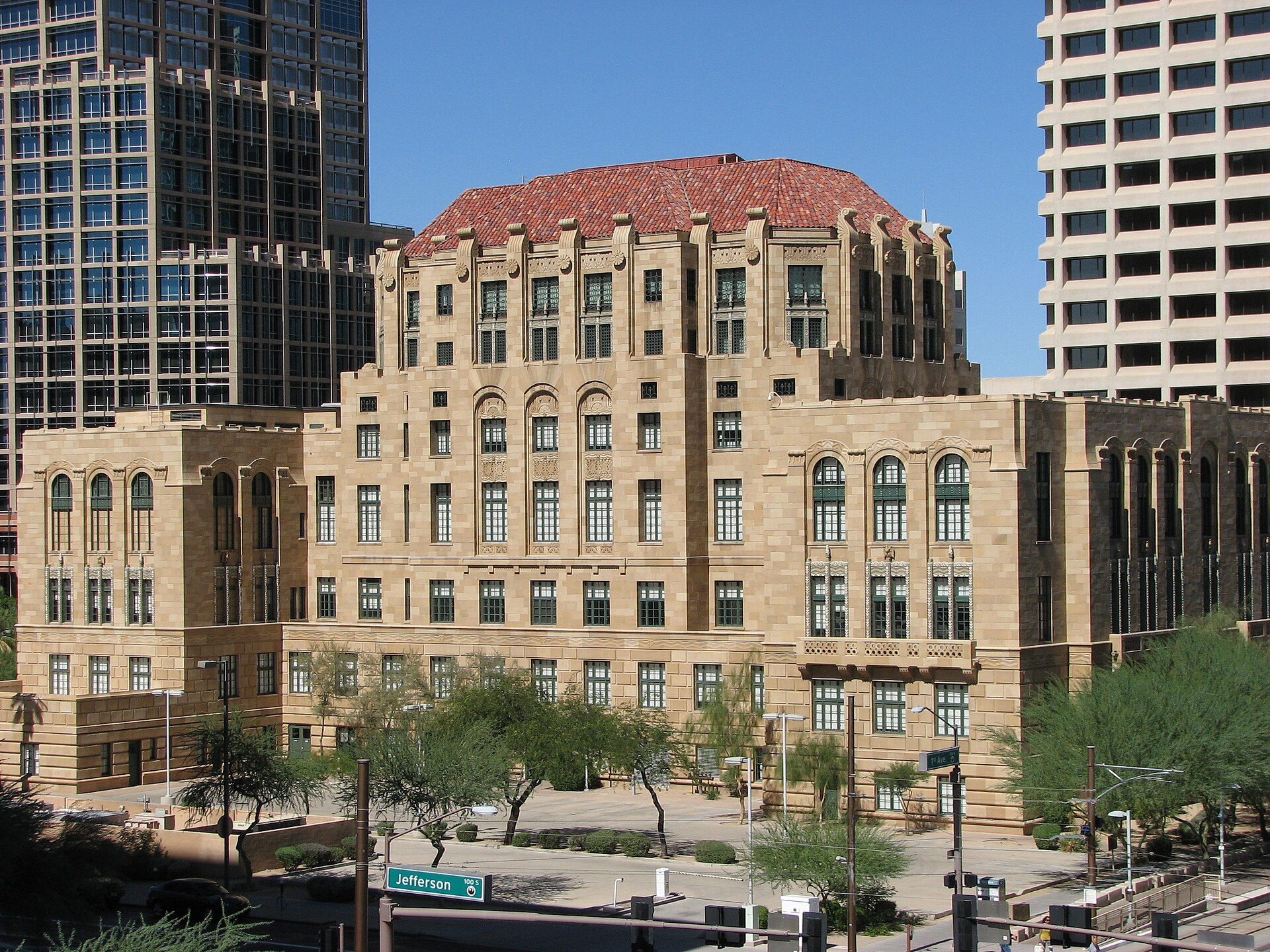
Photo: Zeb Micelli, CC0, via Wikimedia Commons
Upstairs, the Jail
Take the elevator in the Old Courthouse to the sixth floor. The cellblock is still there, restored, and since 2012 it has been the Maricopa County Justice Museum and Learning Center. Admission is free. The museum says that, as far as it knows, no other museum of its kind sits inside a working courthouse.
The exhibits are about Arizona cases that went on to the United States Supreme Court. Miranda v. Arizona is one. In re Gault is another. There is an exhibit on Sandra Day O’Connor, whose name is on the federal building up the street, and a newer exhibit on Arizona women in the law. Artwork that prisoners left on the walls has been preserved.
Where Downtown Eats and Lingers
Go east instead of west and the scale drops. Heritage Square is on a block of the original Phoenix townsite, and the city owns it. The Rosson House, a Queen Anne Victorian from 1895, stands at 113 North Sixth Street and gives guided tours Thursday through Sunday. A carriage house on the square went up in 1899 as a mule barn. In 2026 it houses a coffee shop and flower bar.
Around the corner, at 623 East Adams Street, is Pizzeria Bianco. Chris Bianco’s pizzeria began in 1988 inside a Phoenix grocery store. The visitor bureau calls this the best-known restaurant in Arizona and warns you to expect a wait at dinner. Bar Bianco is next door.
Back toward the courts, the Orpheum Theatre stands at 203 West Adams Street. It was built between 1927 and 1929 for vaudeville, the same years the courthouse was going up. In the 1970s a family named Corona leased it for Spanish-language films and events. The city bought it in 1984, after it had fallen into disrepair, and reopened it on January 28, 1997, with 1,364 seats.
On Saturday mornings the Downtown Phoenix Farmers Market sets up at the Arizona Center, 455 North Third Street, rain or shine, all year. From mid-October to mid-May it runs 8:00 to 1:00. In summer it opens at 7:30 and is done by 11:30. On the first Friday evening of each month, galleries on Roosevelt Row and Grand Avenue open from 6 to 10, an art walk the nonprofit Artlink began promoting in 1994. The street market that grew up around it was suspended in April 2026. That September the city approved a one-year pilot that lets Roosevelt Row businesses host art vendors on their own property, without street closures.
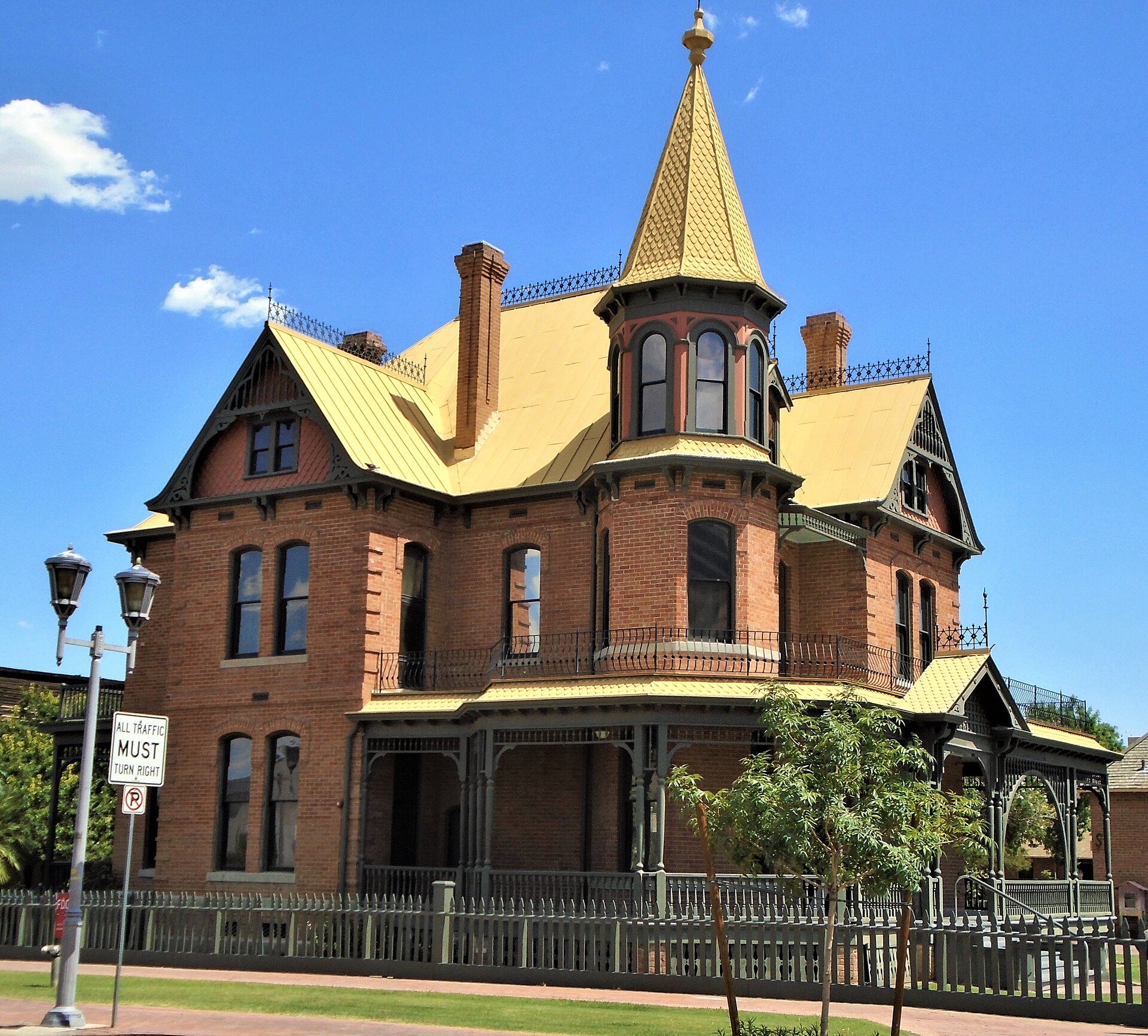
Photo: Beyond My Ken, CC BY-SA 4.0, via Wikimedia Commons
A Court That Posts Its Signs in Spanish
Read the Municipal Court’s language access plan, the 2025 edition, and you learn something about who comes through the doors at 300 West Washington. Spanish leads the court’s list of most-requested interpreter languages. The signs about interpreters are posted in Spanish, Arabic and Vietnamese. The public phone line gives its key instructions in Spanish. The protective order brochure and the payment plan application have been translated.
A court does that because it has to be understood by the people it serves. A law firm has the same job, and it starts earlier, with the first phone call.
Where We Are From
We have no Phoenix past to claim. Our corporation is a California one, on the books since 1998. The man who runs it, Keith A. Bennett, got his start in 1979 with a computer store in Huntington Beach that sold to law firms. By 1980 he was hauling machines into law offices across Los Angeles and Orange County and staying to set up the networks, the billing, the pleading libraries and the phones. Websites for law firms came in 2000. Count every firm since the store opened and the number is close to 1,000. Over 500 of those were website clients.
So the thing we bring to Arizona is not local history. It is a long acquaintance with the inside of a small law office, and a way of working that does not depend on a zip code. The team is small and nobody on it is overseas. Muskegon, Michigan is where the design and development get done. A Phoenix owner would deal with us on a phone call, a video call or a screen we are both looking at.
What We Do for a Firm
For most owners the website is the starting point. Ours are written to sound the way your firm sounds, with schema and search work built into the pages. The price of a new one falls between $2,800 and $4,500. After launch come hosting and care. Any attorney holding a state license pays under $40 a month, and that figure is simply what we pay. Backups are kept, the data center has people in it around the clock, and updates are installed by hand.
Next is the phone. A person picks up and answers the way your firm would. The lead goes into your case system before the call is over, and the attorney gets a warm transfer, with the caller’s name and reason already said out loud. All of it works in Spanish as well as English. The court at 300 West Washington posts its notices in Spanish. A firm that answers only in English will miss some of the same people.
Case-software rescue is for the office that pays every month for Clio, MyCase, PracticePanther, Best Case, Smokeball or LawPay and still keeps the real list on a legal pad. We set the program up again to follow your habits, not the vendor’s demo. Keith’s credentials bear on this. He is a Clio Partner and an 8am Certified Consultant. He is also a Certified Yelp Partner.
AI for law firms comes down to two plain jobs. One is hunting for hours somebody worked and nobody billed, and for subscriptions the firm pays for and has forgotten. The other is teaching the people already on your payroll to use the tools. Weekly social media is handled by our staff if you want it. And when the question is about the business and not about the law, an owner has somebody to call.
No one here will tell you where your site will rank or how many cases the phone will bring. As for Arizona’s rules on lawyer advertising, your own counsel decides what your site may say.
Start Small: $295
Owners tend to begin with the Digital Snapshot, which costs $295. We go through every public thing that bears your firm’s name and write down what we find: your site, your listings, your reviews, and whatever comes up for a stranger searching from the parking garage on Jefferson. Then it is yours. Act on it with us, act on it alone, or put it in a drawer. The pricing page has the other figures, and Keith’s story has its own page.
The jail on the sixth floor is a museum now, and the vaudeville house has its seats back. Phoenix keeps what works and repairs it. The Snapshot is how a firm finds out what still works.
Questions from law firm owners in Phoenix
Can a California agency build a website for a Phoenix law firm?
We can. Law Sites Inc is a California agency and claims no Phoenix history. What we have is long experience with small law offices: Keith Bennett’s computer store opened in 1979, he was in law offices by 1980, and websites followed in 2000. A Phoenix firm would work with us over the phone, on video calls and on a shared screen. Owners usually begin with the Digital Snapshot, at $295.
Many of my callers speak Spanish. Who answers when my Phoenix office is in court?
Our intake people do, in Spanish or English, speaking as your firm. They record the lead in your case system while the caller is on the line, then pass the caller to the attorney with an introduction. How many people call, and how many of them hire you, is not something we can promise.
How much is a new law firm website, and what is the monthly hosting for an Arizona lawyer?
A new site costs between $2,800 and $4,500, with the writing, search work and schema included. Hosting and care run under $40 a month for any state-licensed attorney, Arizona included. That is our own cost, passed along. It buys backups, a data center staffed day and night, and updates installed by a person.
Can AI tools find money a small Phoenix firm is already losing?
Sometimes. The work has two parts. First we hunt for hours somebody worked and nobody billed, and for subscriptions the firm pays for and has forgotten. Then we teach the people already on your payroll to use the tools themselves. What the hunt turns up differs from one office to the next, and we promise no figure ahead of time.