
Every Tuesday at five o’clock the first three blocks of Main Street close to cars. Farmers set out produce, cut flowers, bread and fish. There is live music, and games for the kids. It is called Surf City Nights. It runs until nine from about March through November and until eight in winter, and if the weather holds it happens again next week. You could set a watch by Huntington Beach, as long as the watch only told you the day.
A town with 8.5 miles of beach could get by on the sand alone. This one keeps a calendar instead. One year on it, 1979, is ours, and we will get to it.
A Pier That Kept Coming Back
Main Street ends at the pier, and the pier is the town’s oldest argument with the ocean.
The first one was wood, finished at 1,000 feet in 1904, when the place had only just stopped calling itself Pacific City. A storm in 1910 dropped a large section of it into the water. The next year the town’s trustees approved a bond for a pier of concrete. When that pier opened in 1914, at 1,350 feet, it was called the longest and highest concrete pleasure pier in the United States, and a man named George Freeth gave surf-riding demonstrations at the dedication. He was the first surfer at the Huntington Beach Pier.
A 500-foot extension went on in the 1930s with a café at the far end. Storms in the late 1980s finished what earlier ones had started, and in 1988 the pier was closed as unsafe. Residents formed a group with a name built to spell P.I.E.R., Persons Interested in Expediting Reconstruction, and raised donations. Construction started in October 1990. The pier you walk today, 1,856 feet of it, was dedicated in July 1992. There is still a restaurant at the end.
The city itself dates from 1909, when it incorporated under a mayor named Ed Manning. Close to 200,000 people live here now.
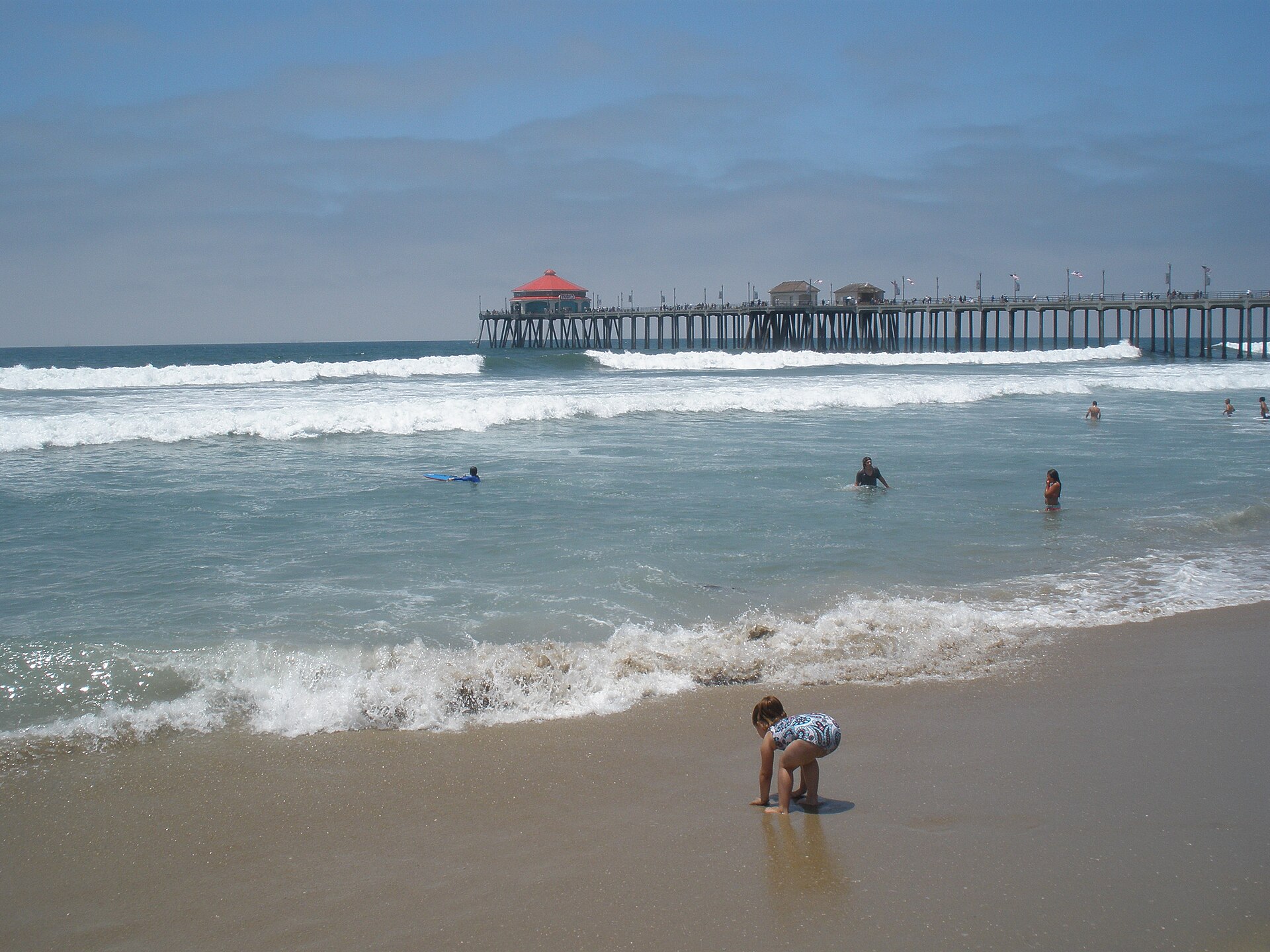
Photo: Imscarr, CC BY-SA 4.0, via Wikimedia Commons
The Corner of Main and Pacific Coast Highway
Stand where Main Street meets the highway and look down.
In front of Jack’s Surfboards, which Jack Hokanson opened on this corner in 1957, the sidewalk holds the plaques of the Surfing Walk of Fame. Nearby, in front of Huntington Surf & Sport, the Surfers’ Hall of Fame keeps handprints, footprints and signatures pressed into the cement. A bronze Duke Kahanamoku has stood there since 2001. He surfed this pier in 1925 with two city lifeguards.
Inland, at the corner of Olive Avenue and 5th Street, the International Surfing Museum sits in a small art deco building painted with surfers. Natalie Kotsch founded it. Inside are boards that belonged to Kahanamoku and Freeth and a cornerstone from the 1914 pier. Above the parking lot hangs a surfboard forty-two feet long.
The nickname came later than all of this. “Surf City” was a Jan and Dean song in the 1960s. The town took it and made it official in 1991.
Twelve Months in Surf City
Here is the year, the way residents meet it.
January opens with the Surf City Splash, a New Year’s run into cold water. In February the Surf City Marathon takes over Pacific Coast Highway. April brings the Jack’s Surfboards Pro to the south side of the pier. In May beach volleyball has set up on the sand next to it, and about 110 old Volkswagen buses line up at the pier for the Kowabunga Van Klan show. June puts classic cars in Central Park, the big park of more than 340 acres where the Central Library has stood on Talbert Avenue since 1975.
Then July. The Fourth here is older than the concrete pier. The 2026 parade was the 122nd, stepping off at ten in the morning after a 5K at seven, with a carnival at Pier Plaza for three days and fireworks over the ocean at nine. Visit Huntington Beach puts the crowd at more than half a million.
Three weeks later the US Open of Surfing fills the south side of the pier for nine days. It is free to watch. Surf contests at this pier go back to 1959, under one name or another, and the event has been called the US Open since 1994.
Fall is Oktoberfest at Old World Village and three days of the Pacific Airshow over the water. In November downtown lights its tree at Magic on Main Street. In December the pier is lit for Light a Light of Love, and over in Huntington Harbour the Philharmonic Committee runs the Cruise of Lights, a fifty-minute narrated boat ride through the harbour’s waterways. Last December’s was the sixty-third.
The city’s own news is not all festivals. This November the city’s home page has been about king tides, with Pacific Coast Highway closing for high water. The ocean still gets a vote.
1979: A Computer Store for Lawyers
In 1979 the pier at the end of Main Street was the old concrete one, the one the storms had not yet closed. That year Keith A. Bennett opened a computer store in Huntington Beach. It catered to law firms.
A computer store for lawyers was a narrow thing to open in 1979. The work turned out to last. By 1980 Keith was carrying computers into law offices well beyond the beach: Century City and Wilshire, Encino, Irvine, and Santa Ana across from the courthouses. He put in networks, WordPerfect and then Word, billing, pleading libraries and phone systems.
So the agency behind this page did not start with websites. It started in this town, with the back office of a law firm. Law Sites Inc. became a California corporation in 1998 and has been building law firm websites since 2000. The count of law firms served over the years has come close to 1,000, and more than 500 of those were websites. Keith has lived in Southern California all his life, and Huntington Beach is one of the places he has called home.
What That Means for a Firm Here Now
For a law firm owner, Huntington Beach has one drawback. The town is loud. Half a million people come for one holiday. The visitors bureau, the surf brands and the restaurants are all very good at being found. A small law office is competing for attention in a place that is expert at getting it.
You do not answer that by shouting. You answer it by being findable and by being in when someone calls.
Findable is the website. We write it to sound like your firm and nobody else’s, with search work and schema built in. A state-licensed attorney pays under $40 a month for hosting and care, which is what it costs us, with backups, updates applied by hand and a data center staffed day and night.
Being in is the phone. A person answers as your firm, in English or Spanish, enters the lead in your case system before hanging up, and puts the caller through to you with an introduction.
The rest is the back office, where this agency started. Case-software rescue is for firms that bought Clio, MyCase, PracticePanther, Best Case, Smokeball or LawPay and never got them to fit the way the office works. Keith is a Certified Yelp Partner and a Clio Partner. He is an 8am Certified Consultant as well. AI for law firms means we look for unbilled work and wasted subscriptions, and we teach your staff to use the tools themselves. Our own staff posts your social media weekly. And there is a person to talk with about the business side of the practice. Not the law. The business.
No one here will promise you a ranking or a number of new clients. If a question comes up about what the attorney advertising rules allow on a page, your own counsel decides it.
The First Step Costs $295
It is called the Digital Snapshot. We go through everything with your firm’s name on it and write down what we find, good and bad, in plain sentences. Most firms start there. You may stop there and fix what it finds yourself. If one of the situations we describe sounds like yours, the Snapshot will say so. Rates for everything else are on the pricing page.
We are a small team in the United States. Design and development happen in Muskegon, Michigan. Everything is done by phone, by video and on a shared screen. Main Street can close to cars every Tuesday and it changes nothing for us.
The pier has been rebuilt more than once and people never stopped walking to the end of it. A practice can be kept up that way too. Start with the Snapshot, or read how Keith got here.
Questions from law firm owners in Huntington Beach
Who builds websites for small law firms in Huntington Beach?
Law Sites Inc builds websites for small law firms, and it started in this town. The agency traces back to a computer store Keith Bennett opened in Huntington Beach in 1979 that catered to law firms. Incorporated in California in 1998, the agency turned to law firm websites in 2000. Sites are written in the firm’s voice, with search work and schema included.
Do you handle social media for a law firm, or do we have to write the posts ourselves?
Our own staff posts for the firm every week, so the writing does not fall to you or your assistant. It is one part of a longer list that includes websites, phones and intake, and case software. If you are not sure social media is where your firm should start, the $295 Digital Snapshot is the better first step.
I do not need a new website. I need to talk through a decision about the practice. Is that something you do?
Yes. One of the things we offer is a person to talk with about the business side of a practice. Not the law. The business. It happens the way all our work does, by phone, by video or on a shared screen. Keith Bennett has been working with law offices since he opened his Huntington Beach store in 1979.
Is the $295 Digital Snapshot a sales pitch or a real report?
It is a written inspection. We look at everything carrying your firm’s name, including the website, directory listings and reviews, and put what we find in writing. For most firms it is the first step. What you do with it is up to you, and nothing in it promises rankings or leads.