
On a Saturday morning in Muskegon, in any month, the crowd is at 242 West Western Avenue. That is the Muskegon Farmers Market, which the city owns and runs. From May through November it opens Tuesdays, Thursdays and Saturdays. From December through April it keeps Saturdays only. The market’s own site puts a Saturday between June and October at 8,000 to 10,000 visitors.
A shopping mall once stood on this ground. The market’s history page says so without ceremony: the Muskegon Mall was here until it came down in 2003. In 2013 the city approved, on a 6 to 1 vote, a new market on the site, to be built with private money. It opened in 2014 on four acres, with 170 vendor stalls, a stage, indoor room for winter, and a commercial kitchen named Kitchen 242 after the address.
The market is far older than the address. It began in the late 1880s as a place to sell wood and hay. Farmers were first allowed to sell produce there in 1921. It moved to East Webster Avenue in 1936 and to Yuba Street in 1964.
Twelve Sheds and a Theater
A little way along the avenue, at 307 West Western, is the Western Market. It is a row of small painted buildings the city calls chalets. Twelve of them opened in May 2017. Each was a portable wooden shop of 90 to 150 square feet, with a door and windows and no running water, built for $5,000 to $6,000 with money given by the chamber of commerce, a community foundation and others. A first-time shopkeeper could try a business there without signing for a storefront. By early 2018, Strong Towns reported a waiting list of more than 25 owners, and a bakery that began in a chalet was opening a permanent shop downtown.
The chalets are still at it. The 2026 season opened on Saturday, May 23, with a schedule running to the end of October.
Farther along is the Frauenthal Center, at 425 West Western. It was built in 1929 by a Muskegon movie man, Paul Schlossman, for $600,000, to a design by C. Howard Crane. It opened as the Michigan Theater on September 16, 1930, with a picture called Queen High. The theater went dark in the 1970s. In 1976 a local industrialist, A. Harold Frauenthal, put up the money for the Community Foundation for Muskegon County to buy the block. County voters later backed a bond for the restoration, which was done in the 1990s, and the foundation still owns the building and runs it.
A mall becomes a market. A dead theater gets its lights back. Downtown Muskegon has a habit of fixing its front door instead of moving away from it. We pay attention to that, because our own design and development work is done in this town.
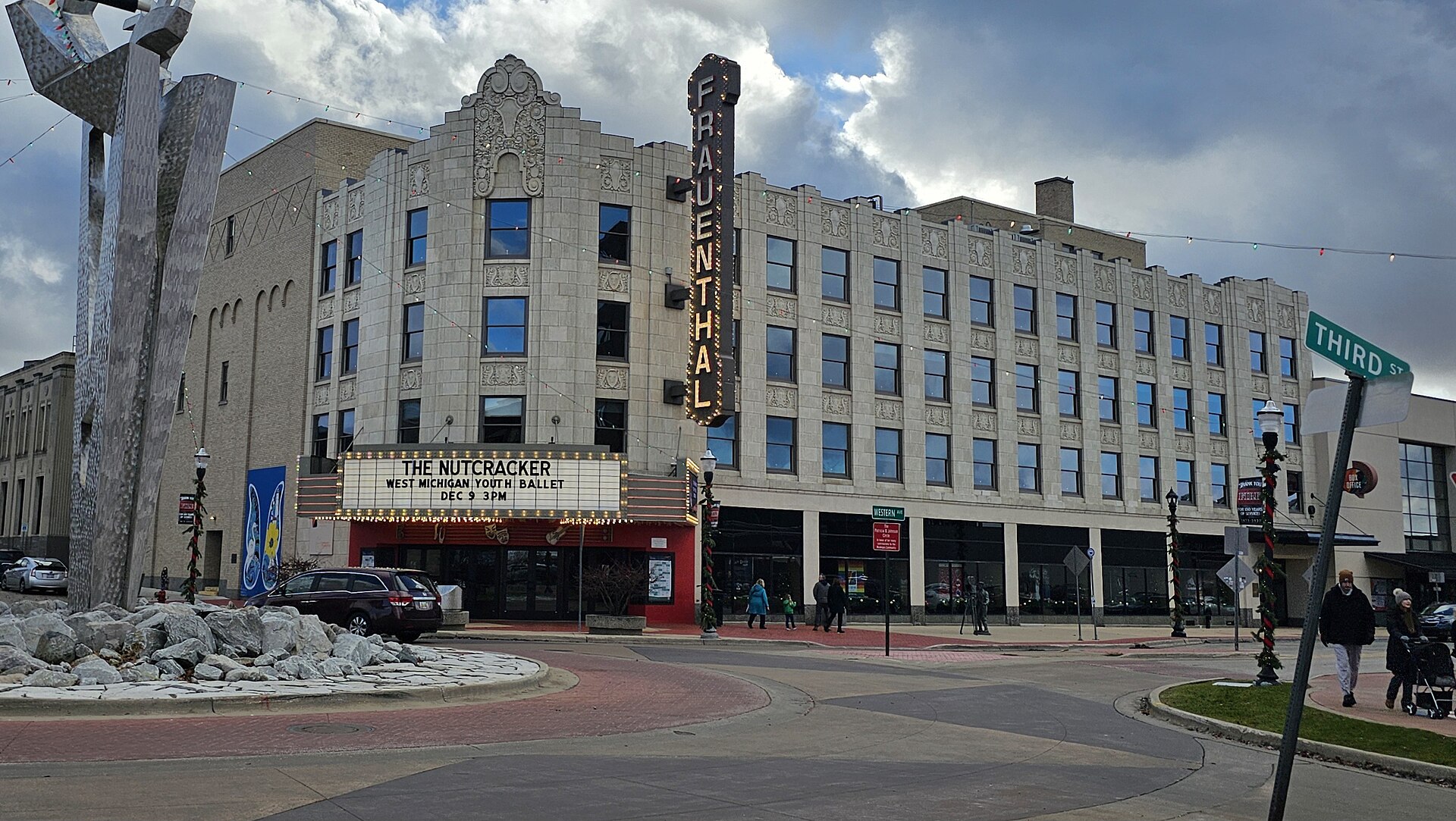
Photo: JJonahJackalope, CC BY-SA 4.0, via Wikimedia Commons
The Block Hackley Gave
The oldest example of the habit is downtown too. Hackley Park is 2.3 acres, one full city block bounded by Webster, Clay, Third and Fourth. The lumberman Charles H. Hackley presented it to the city in 1890, dedicated to the memory of Civil War veterans. A soldiers’ monument about eighty feet tall stands in the middle. Lincoln, Grant, Sherman and Farragut hold the four corners, and four diagonal walks run from the corners to the column.
The city keeps one rule for the park. It can be reserved only for events open to the public. Private parties are not allowed. In 2026 the Lakeshore Art Festival set up downtown on June 27 and 28 with nearly 250 booths.
Hackley’s first gift to the town was a library, at 316 West Webster Avenue. It was built in 1888 and 1889 of pink granite with sandstone trim, and the building and its contents cost him more than $100,000. The Society of Architectural Historians notes that he had first planned a modest library built of donated lumber and chose stone because of the risk of fire. A lumberman knew what burns.
The Muskegon Museum of Art was established in 1912 through Hackley’s bequest. On February 6, 2025, it opened the Bennett Schmidt Pavilion, a $15.4 million addition with four new galleries, one of them underground for prints.
The county’s visitor bureau quotes Hackley this way: “A rich man to a great extent owes his fortune to the public.” He paid the debt in buildings people still walk into.
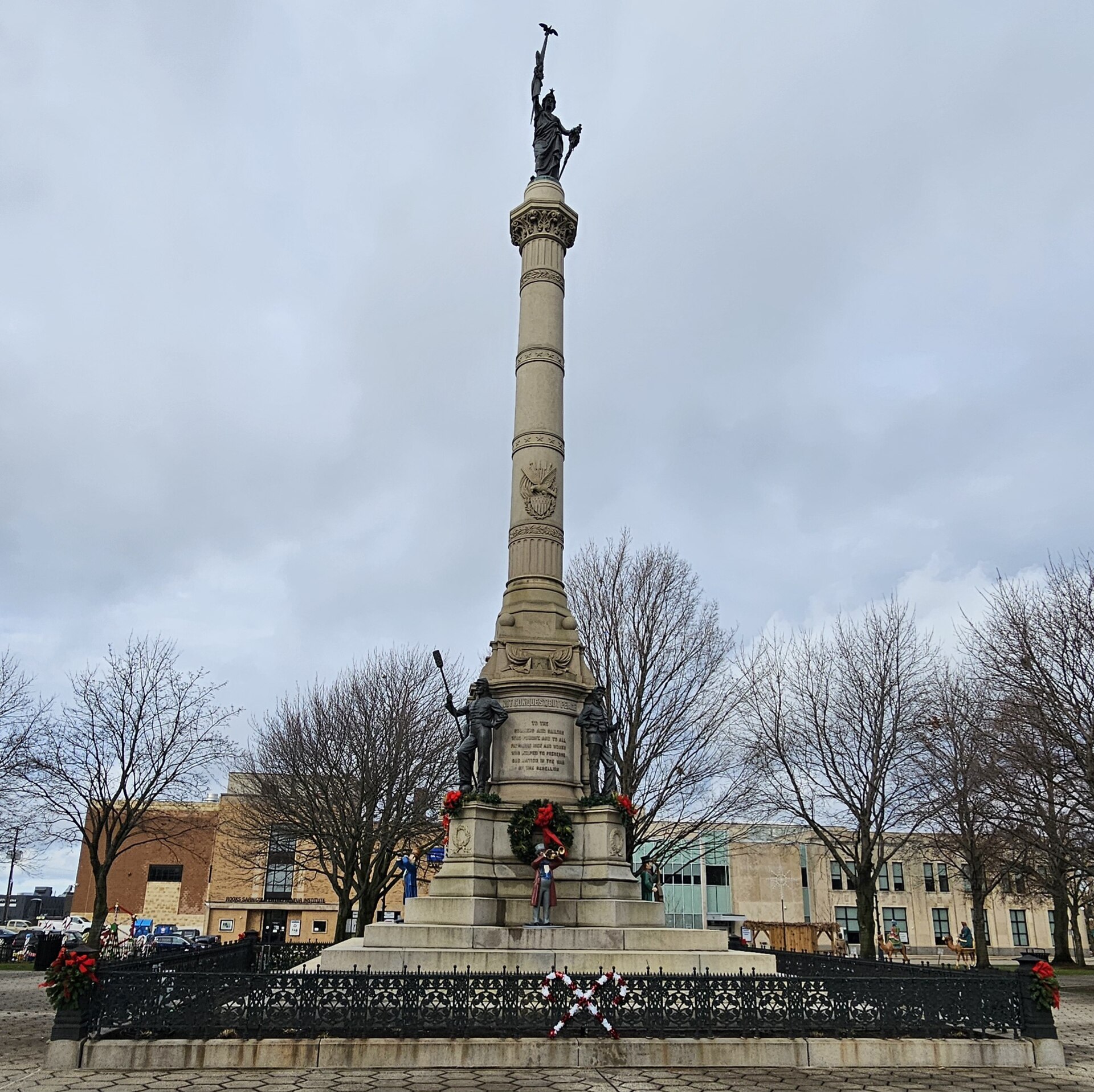
Photo: JJonahJackalope, CC BY-SA 4.0, via Wikimedia Commons
990 Terrace Street
For a Muskegon County lawyer, nearly everything happens at one address. The Michael E. Kobza Hall of Justice, 990 Terrace Street, holds all three of the county’s trial courts.
The 60th District Court is in Suite 100. Its office hours are 8:30 to 4:30 on weekdays. It takes the smaller civil suits, small claims, evictions, misdemeanors and traffic, and felony cases take their first steps here too.
The 14th Circuit Court takes the felonies, the larger civil claims, personal protection orders, and the family matters: divorce, custody, paternity and child support.
Probate is on the fifth floor, in Suite 500. The Muskegon County Probate Court handles estates, guardianships and conservatorships. Its office hours have a gap a newcomer learns once: 8:30 to noon, then 1:00 to 4:30.
Michigan Legal Help lists two self-help centers in the building as well, one for district court matters and one, on the sixth floor, for circuit. Their staff can explain legal information. They cannot give legal advice, and they say so.
One thing is not on Terrace Street. Bankruptcy is federal. Muskegon is one of nine counties assigned to the Grand Rapids office of the bankruptcy court for Michigan’s Western District, at 1 Division Avenue North.
So a tenant with a notice, a couple splitting up and a family with a will to file all come through the same doors. Some of them will go looking for a lawyer before they get home.
Why Muskegon Is on Our Own Footer
Law Sites Inc is an agency for law firm owners. Keith A. Bennett runs it from Southern California. Our designers and developers work in Muskegon, which is why the town is one of two places named at the bottom of our own site. When a page of ours gets drawn and coded, that happens here, on this shore.
Keith’s history with law offices is a California one. His computer store in Huntington Beach dates to 1979. It sold to law firms, and from 1980 on he was inside their offices setting up networks, word processing, billing and phone systems. California has had the company on its books as a corporation since 1998. Its first law firm websites went up in 2000. Counting from the store, the firms served come to nearly 1,000, and for more than 500 of them the job was a website.
A law office runs on the same parts in Michigan as in California: a phone, a calendar, a billing system, and a front door people can find.
A Front Door, Kept Up
That front door is now a screen. Here is what we do about it.
Websites come first. Each one is written to sound like the lawyer it belongs to, with schema and search work handled underneath. A site is priced from $2,800 at the low end to $4,500 at the high end. After that, a state-licensed attorney pays less than $40 monthly for hosting and care. That figure is what the service costs us. It buys backups, updates a person applies by hand, and a data center with people in it at all hours.
Phones and intake is the second piece. Your line is picked up by a person who sounds like your office, in Spanish or English as the caller prefers. Before the call ends, the lead is sitting in your case system. Then the attorney gets the caller, along with a sentence about who is calling and why.
Case-software rescue helps an office that pays for Clio, MyCase, Smokeball, PracticePanther, LawPay or Best Case and has never made the program fit the way the staff really works. Keith’s credentials here: 8am Certified Consultant and Clio Partner. He is also a Certified Yelp Partner.
Our AI for law firms work is two plain searches, one for hours worked and never billed and one for subscriptions nobody opens, followed by lessons for your own people. Our staff can also post your social media each week. And Keith will talk through the business of a practice with you. The law stays yours.
None of this comes with a promise about rankings or how many calls arrive. As for the rules on attorney advertising, your own counsel decides whether a given sentence passes.
Begin With $295
Most firms start small, with the Digital Snapshot, which is $295. We go looking for your firm’s name wherever it appears and report back in writing: your website, your listings, your reviews, and what a stranger finds on searching for you. The situations page on our site shows the kind of thing an inspection turns up. Other rates are on the pricing page.
We work by telephone, by video call and on a screen both sides can see. That holds for a firm near Terrace Street as much as for one three time zones away.
Muskegon tore down a mall and put a market on the lot, and summer Saturdays there now draw thousands. A firm’s front door can be rebuilt the same way, one piece at a time. Order the Snapshot, or read how Keith came to this work.
Questions from law firm owners in Muskegon
Does Law Sites Inc work with law firms in Muskegon County?
We can. Our design and development work is done in Muskegon, and the agency is run from Southern California, where Keith Bennett has worked with law offices since 1980. We work on calls, on video and on a screen both sides can see, so a firm near the Hall of Justice is as easy to serve as any other.
How much is a law firm website for a Michigan attorney?
The site itself is priced from $2,800 up to $4,500. We write it to sound like you and finish it with schema and search work. Once it is live, hosting and care come to under $40 each month for a state-licensed attorney, which is simply what we are charged. Plenty of firms order the Digital Snapshot first, at $295, before deciding whether to rebuild anything.
Can someone answer my Muskegon firm’s phone and enter the lead in my case software?
That is our phones and intake service. Your line is picked up by a person who sounds like your office, in Spanish or English. By the time the caller hangs up the lead is already recorded in the case system, and the attorney receives the caller with a short introduction. How many people call is not something we can promise. Our part is treating each caller well.
What is the Digital Snapshot, and what would a Muskegon firm get for $295?
A written report. We go looking for your firm’s name wherever it appears and tell you what we found: your website, your listings, your reviews, and what a stranger finds on searching for you. The situations page on our site shows the kind of thing an inspection turns up. Nothing in it promises rankings or calls. What you do with it is up to you.