
Twenty-fifth Street has two names. The General Services Administration lists its building there at 601 25th Street. The federal court that sits inside says Rosenberg. Its Galveston Division gives the address as 601 Rosenberg, and the juror page spells it out for strangers: 601 Rosenberg (25th Street), Clerk’s Office, Room 411, fourth floor.
Follow the same street south until the island runs out and the number on the last building is 2501 Seawall Boulevard. That is the Pleasure Pier. One end of 25th Street is a federal courtroom. The other end is a roller coaster over the Gulf.
A lawyer on Galveston Island works between those two things, and most days knows which one the client would rather be at.
The Limestone Building on 25th
The building at 601 is the United States Post Office and Courthouse. The General Services Administration, which keeps it, dates it to 1937 and credits the design to Alfred Finn. It is Art Deco, clad in a fossil-bearing limestone. The GSA tells a small story about that stone. The first plan called for brick. A congressman and the local collector of customs pressed the Treasury Department for limestone, and they got it. The building went up on the site of an earlier federal building from the 1890s, and it is on the National Register of Historic Places.
Inside sits the Galveston Division of the U.S. District Court for the Southern District of Texas. The division takes in four counties: Brazoria, Chambers, Galveston and Matagorda. When the district was created, Galveston was one of its four places of holding court, with Brownsville, Houston and Laredo. The clerk’s office keeps hours of 8:00 a.m. to 5:00 p.m., Monday through Friday. A government photo ID is required at the door. Phones may come in, but they stay quiet in the courtroom unless the judge says otherwise.
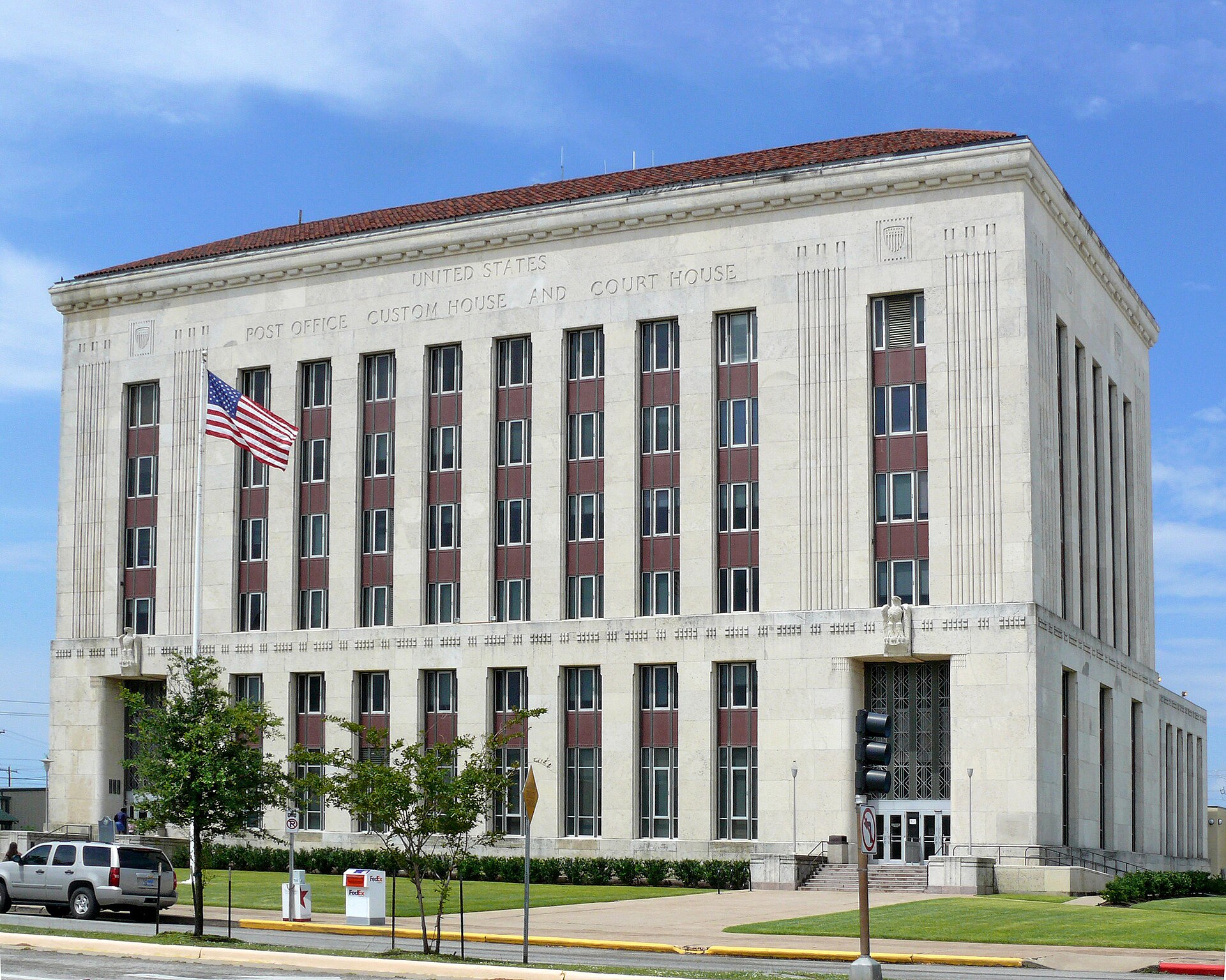
Photo: Jim Evans, CC BY-SA 4.0, via Wikimedia Commons
600 59th Street
The county’s courts are thirty-odd blocks west, at the Galveston County Justice Center, 600 59th Street. The county’s law enforcement building is a few blocks off, on 54th.
Galveston County lists six district courts, three county courts at law and a Probate Court, which sits in Suite 2305. The county posts hours of 8:00 a.m. to 5:00 p.m., Monday through Friday.
The county is bigger than the island, and the District Clerk says so with a second office on the mainland, at 174 Calder Road in League City.
The older address still matters. The county lists its Courthouse at 722 Moody Avenue, which is 21st Street, and its Commissioners Court page gives that address as the county seat. The block has been courthouse ground for a long time. The visitor bureau’s Freedom Walk notes that on June 19, 1865, after General Order No. 3 was issued at Union headquarters on the Strand, soldiers are thought to have marched on to the Old Courthouse Square on 21st Street. The walk also says that early Juneteenth celebrations marched from the county courthouse to Reedy Chapel on Broadway, and that the tradition is still observed.
The Strand, Which Is Really Avenue B
On the map the Strand is Avenue B. It was in the original plat of the city in the late 1830s, and the Handbook of Texas says nobody knows where the nickname came from. What people mean by it is five blocks, 20th Street to 25th, running parallel to the bay.
In the nineteenth century it was called the Wall Street of the Southwest. The Handbook counts 700 to 1,400 vessels a year in the harbor in those decades, and $38 million in goods and services sold in the district in 1881. Two of the Hendley Row buildings date to 1855 and 1859. Nicholas Clayton, the city’s leading architect of the period, designed fifteen commercial buildings on the Strand, and eight are still standing.
The 1900 hurricane was the turning point, the Handbook says, and the saving came much later. The Junior League restored two buildings in the 1960s. In 1973 the Galveston Historical Foundation set up a revolving fund to save more. The Foundation’s office is at 2002 Strand.
On the east wall of the Old Galveston Square building on the Strand, a 5,000-square-foot mural called Absolute Equality stands near the place where General Order No. 3 was issued. A state historical marker is beside it. The Osterman Building, where the Union Army kept its headquarters, is gone. A short walk away, at 502 20th Street, the old U.S. Customs House is not gone. It was finished in 1861, and the Freedom Walk calls it the first non-military building the federal government put up in Texas.
In December the Foundation puts on Dickens on The Strand, a festival modeled on Victorian London. The 2026 edition, which the Foundation bills as the 53rd annual, is set for December 4 through 6.
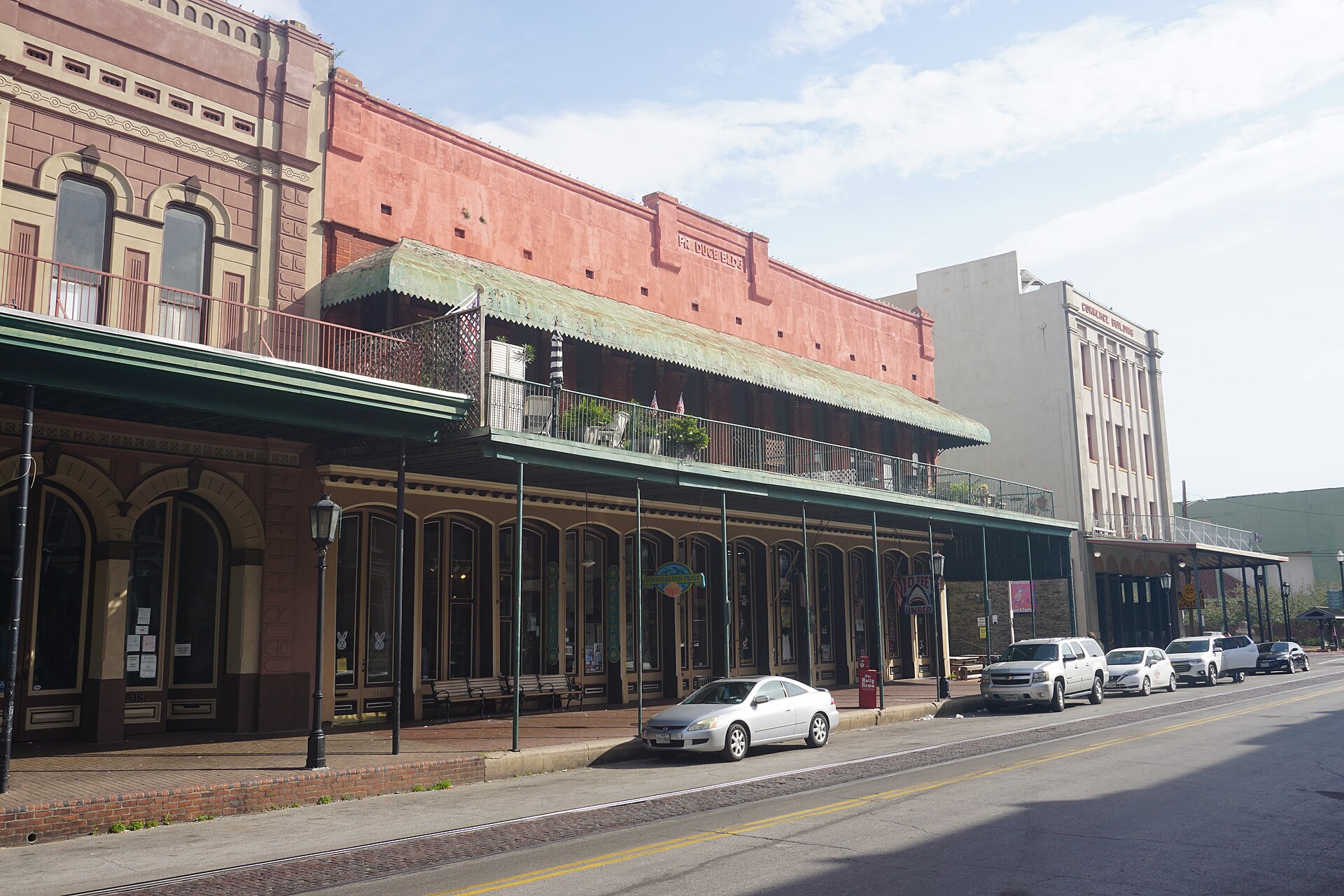
Photo: Michael Barera, CC BY-SA 4.0, via Wikimedia Commons
The Wall and What Sits on It
The city’s own history page is blunt about why the island looks the way it does. The 1900 storm killed 6,000 people and left 8,000 without homes. The first section of the seawall was finished in 1904. Then the city raised itself: 2,200 structures were lifted, an average of five feet.
The wall kept growing until 1963. The visitor bureau puts it at more than ten miles today and calls the walk along its top the longest continuous sidewalk in the country. Runners use it, and cyclists, and skaters, and families pedaling rented surreys.
Gaido’s has been serving Gulf seafood on Seawall Boulevard since 1911. The Pleasure Pier’s first version opened in the 1940s, and Hurricane Carla wrecked most of it in 1961. The present pier opened in 2012 with a roller coaster called the Iron Shark and a wheel called the Galaxy.
Where We Come Into It
Law Sites Inc is a California corporation, formed in 1998. Keith A. Bennett, who runs it, has lived in Southern California all his life. The store he opened in Huntington Beach in 1979 was built around law firms. By 1980 he was the one wiring their networks and setting up their word processing, billing, pleading libraries and phones. The websites started in 2000. Nearly 1,000 law firms have come through since the store opened, more than 500 of them for a website.
None of that happened on Galveston Island. What we know is the inside of a law office, and that travels. The work is done by phone, on video and over a shared screen, wherever the firm is.
What an Island Firm Is Selling Against
A Galveston lawyer’s future client may be a longtime islander with a probate matter headed for Suite 2305. It may be someone on the mainland side of the county who has never been inside the Justice Center. It may be a visitor whose weekend on the Seawall went wrong. All three start the same way, with a phone and a search, and then a call that somebody answers or does not.
Those two moments are our work.
Websites. We write the site the way your firm talks, and we do the search work and the schema underneath it. Sites run from $2,800 to $4,500. After that an attorney with a state license pays under $40 a month for hosting and care. We charge what we are charged. The money covers backups, a data center with staff on duty at all hours, and updates put in by hand.
Phones and intake. A caller hears your firm’s name and your firm’s manner. The details are in your case system before the call ends. Then the attorney is told who is waiting and why, and takes the call. English and Spanish, both.
Case-software rescue. Smokeball, Best Case, LawPay, PracticePanther, MyCase and Clio, rebuilt around the way your office moves a file from first call to closing letter. Keith comes to that job as a Clio Partner and an 8am Certified Consultant, and he is a Certified Yelp Partner too.
AI for law firms. We hunt for time that was worked and never billed, and for software the firm pays for and has stopped opening. Then we train your own staff on the tools.
There is also someone to talk with about the business side of the practice. Not the law. That is yours.
We do not promise rankings, calls or cases. And whether any sentence on your site fits the attorney advertising rules is for your own counsel to decide.
The First Step Costs $295
Most firms start with the Digital Snapshot. We look at whatever a stranger can find under your firm’s name, the website, the listings, the reviews and the search results, and we put it in writing. You read it and decide whether anything comes next. Everything else is on the pricing page. If you want to know whether your trouble is a common one, the situations page lays several out.
We are a small outfit, all of us in the United States, with the designers and developers in Muskegon, Michigan.
The Seawall does not close, and neither does a search. Read about Keith, or order the Snapshot and find out what your firm looks like from the other end of 25th Street.
Questions from law firm owners in Galveston
Do you work with law firms on Galveston Island?
We can. Law Sites Inc is a California corporation that has built law firm websites since 2000, and we have no office or history on the island. We work with a firm by phone, video and shared screen, wherever it practices. Most firms begin with the $295 Digital Snapshot, a written inspection of everything carrying the firm’s name.
What does a law firm website cost for a Galveston practice?
A site runs from $2,800 to $4,500. We write it the way your firm talks and do the search work and schema underneath. After that, an attorney with a state license pays under $40 a month for hosting and care, with backups and hand-applied updates included. The pricing page lists the rest. None of it comes with a promise about rankings or calls.
Is there someone a Galveston firm owner can talk to about the business, not the law?
There is. Keith Bennett has been inside law offices since 1980, first with their networks, billing and phone systems and, since 2000, with their websites. He talks with owners by phone or video about the business side of a practice. The law stays yours. Most firms start with the $295 Digital Snapshot, which puts something in writing to talk about.
We already pay for Clio or MyCase. Can you fix how a Texas firm uses it?
We can look at it with you over a shared screen. Case-software rescue covers Smokeball, Best Case, LawPay, PracticePanther, MyCase and Clio, arranged around the way your office handles a matter. Keith Bennett is an 8am Certified Consultant and a Clio Partner. Questions about court rules or filing requirements stay with you and your counsel.