
Boston never gathered its courts into one civic center. A lawyer with a small practice here works a triangle instead: a square tucked between the State House and Government Center, a street called New Chardon, and a pier on the harbor. Each corner has its own building and its own door.
Pemberton Square: Two Courthouses, Side by Side
The older of the two is the John Adams Courthouse. George A. Clough, the city architect, designed it with arches, columns and pediments, and it was finished in 1894 at a cost of about $3.8 million. Clough came back in 1909 to add two more stories under a mansard roof.
Go inside for the Great Hall. The ceiling is a barrel vault with the seal of the Commonwealth in its central panel. Sixteen life-sized figures by the sculptor Domingo Mora stand around it, among them Law, Justice, Wisdom and Legislation. A bronze of the lawyer Rufus Choate, by Daniel Chester French, was made for the building’s opening. The state describes the hall as a corridor that joins Pemberton Square and Government Center to Ashburton Place and the State House.
For most of its life the building was simply the Suffolk County Courthouse. An act signed on May 14, 2002 gave it John Adams’s name. A restoration finished in 2005 brought home the Supreme Judicial Court and the Social Law Library, and the Appeals Court moved in with them. Visitors are generally welcome on business days between 8:30 in the morning and 4:30 in the afternoon. Two exhibit rooms open off the Great Hall, one about Adams and one about the trial of Sacco and Vanzetti. The Supreme Judicial Court hears oral arguments in the first full week of each month, September through May, and the public may sit in.
Next door is the tower. The state’s own history calls it the “New” Suffolk County Courthouse, an Art Deco high-rise by the firm of Desmond & Lord, and the high court moved into it in 1939. The address is 3 Pemberton Square, and this is where Suffolk County Superior Court keeps its clerks: civil on the 12th floor, criminal on the 14th. The court serves Boston, Chelsea, Revere and Winthrop. The Land Court keeps the same address and takes cases from the whole Commonwealth.
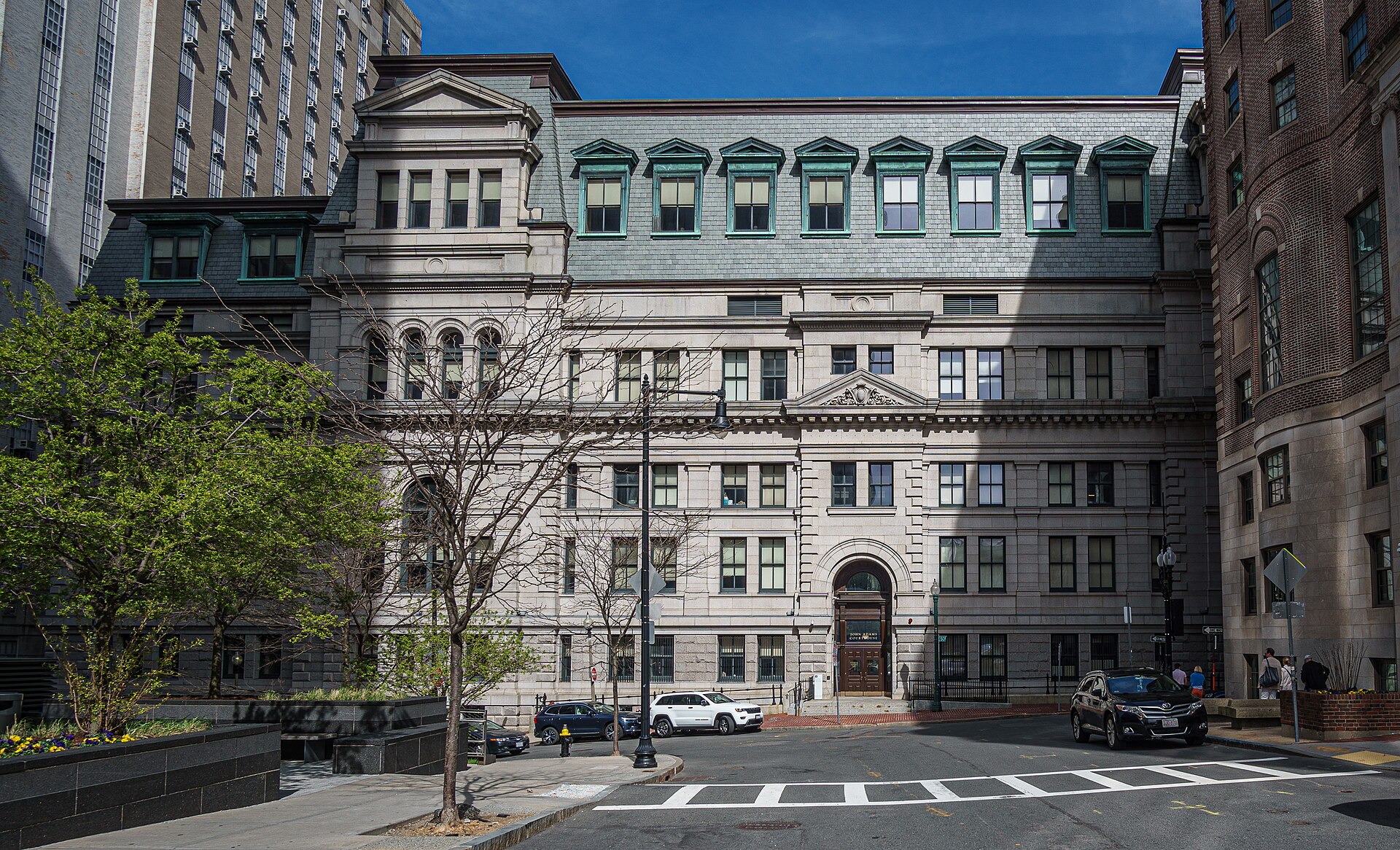
Photo: Kenneth C. Zirkel, CC BY 4.0, via Wikimedia Commons
New Chardon Street: The Door Most Clients Use
The second corner is the Edward W. Brooke Courthouse at 24 New Chardon Street.
Four courts list this address. The Central Division of the Boston Municipal Court is one of eight divisions the court keeps around the city, and it covers downtown, Chinatown, the North End, the West End, Beacon Hill and the South End as far as Massachusetts Avenue. The Boston session of the Eastern Housing Court is here. So are the Suffolk Probate and Family Court and the Boston Juvenile Court.
The court pages are plain about the car: there is no public parking at this courthouse. They point you to the T instead, the Orange, Green, Blue and Red lines, with commuter rail at North Station. Two more lines on those pages are worth a lawyer’s notice. The Municipal Court says a lawyer for the day is available on site. The Housing Court says a free interpreter can be requested through the clerk’s office. Read those together and you have a fair idea who is in the lobby at 8:30: people who came without a lawyer, some of them more at home in another language.
Between Hearings
The blocks near the two state corners are where downtown Boston eats lunch.
At 100 Hanover Street the Boston Public Market has been open since July 30, 2015. It is indoors, it runs all year, and it sits directly above the Haymarket T station. More than 30 New England growers and food makers sell there.
Outside, on Fridays and Saturdays, the older trade goes on. Haymarket sets up along Blackstone, Hanover and North streets. Meet Boston, the visitor bureau, calls it the city’s oldest open-air market and counted more than 40 vendors of fruit, vegetables and seafood in a 2026 guide.
At 41 Union Street is the Union Oyster House. It first opened to diners in 1826, in a building that dates to 1716 or 1717. The National Park Service calls it the oldest restaurant in continuous service in the country. The oyster bar is a half circle of oak around the shucking table, with nine stools. Daniel Webster was a regular. Booth 18, upstairs, was a favorite of John F. Kennedy and was dedicated to his memory in 1977.
Where an elevated expressway once ran, the Rose Fitzgerald Kennedy Greenway has made a mile and a half of park since 2008.
Fan Pier: The Federal Corner
The third corner is on the water. The John Joseph Moakley U.S. Courthouse, at 1 Courthouse Way on Fan Pier, was completed in 1998. It is the headquarters of the U.S. District Court, District of Massachusetts, and the clerk of the U.S. Court of Appeals for the First Circuit keeps an office in the building.
Henry N. Cobb designed it, and about half the site was given over to a public park: a promenade along a granite seawall, a great lawn, and a raised seating area at the eastern point called the Prow. Boats for the Harbor Islands leave from a dock beside it.
The court’s instructions are specific. The public comes in from Northern Avenue. The Fan Pier entrance is for employees and for people carrying bar cards or media credentials. Bring a photo ID. The court’s page says electronics are not permitted inside unless you are credentialed to carry them, so check it before you go.
Bankruptcy is a fourth stop. The U.S. Bankruptcy Court for the District of Massachusetts sits in the John W. McCormack Post Office and Court House at 5 Post Office Square.
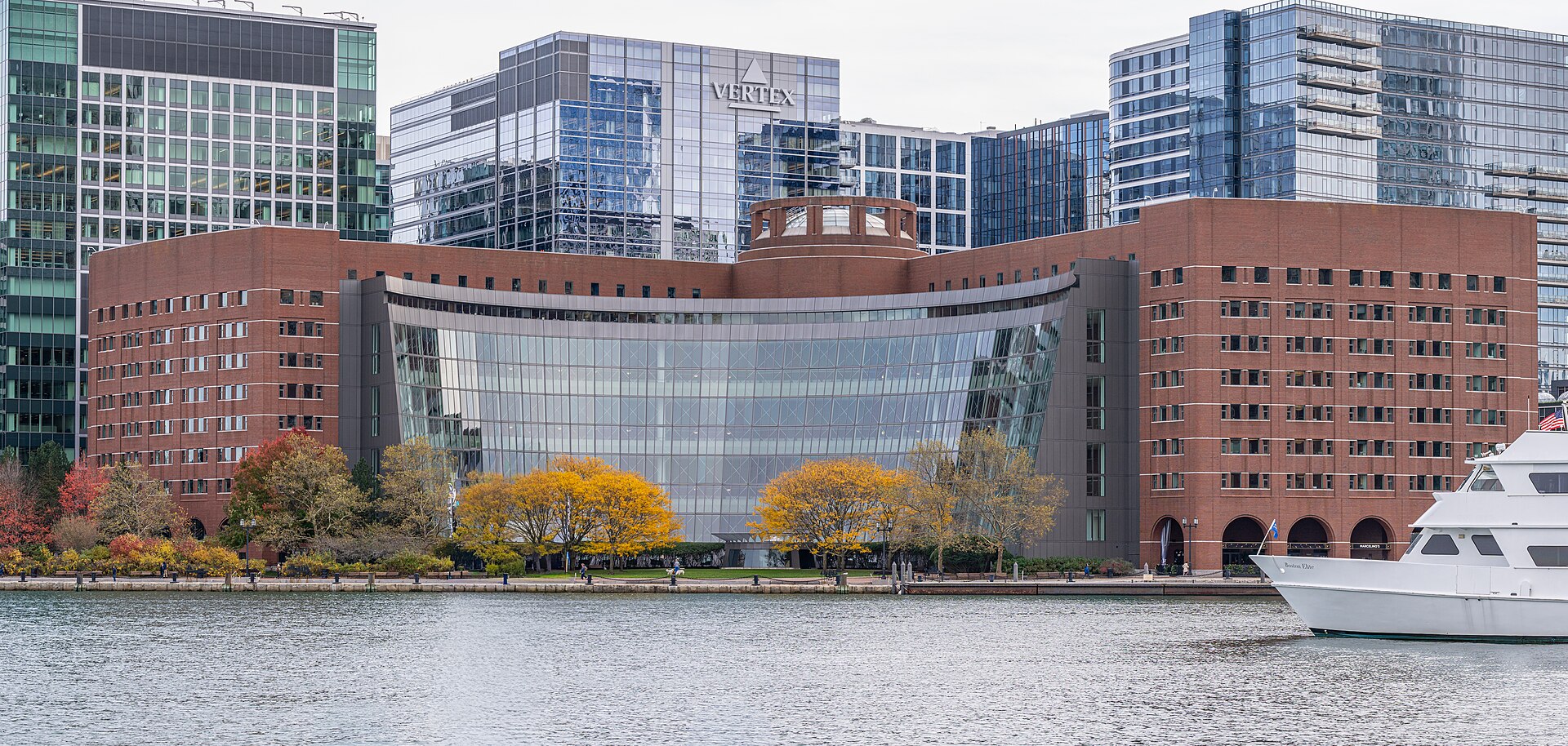
Photo: ajay_suresh, CC BY 4.0, via Wikimedia Commons
An Agency From the Other Coast
Nothing on this page so far involves us, and that is deliberate. Our company was incorporated in California in 1998 under the name Law Sites Inc. No Boston office exists, and no chapter of our story takes place on Pemberton Square.
Here is the history we do own. In 1979 Keith A. Bennett, the owner, started selling computers to law firms out of a store in Huntington Beach. Come 1980 he was hauling the machines into law offices and setting up what ran on them: the network, the word processor, the billing, the library of pleadings, the telephones. Websites for law firms followed in 2000. The tally since the store opened is close to 1,000 law firms, and for more than 500 the job was a website.
We are a small crew, every one of us in the United States. The designers and developers are in Michigan, in the city of Muskegon. A Boston firm would deal with us as all firms do: by phone, by video, or with your screen shared to ours.
The Search After the Lobby
Go back to New Chardon Street. Some of the people who walk in alone learn that the matter will take a lawyer. At some point they type a name into a search box. Then, maybe, they dial.
Two things decide what happens next.
One is the site itself. It should sound like the lawyers whose names are on the door, so that is how we write it, with the search groundwork and schema built in beneath the words. For the build, expect $2,800 at the low end and $4,500 at the high end. Keeping it hosted and looked after is priced at what we pay, below $40 monthly for any attorney holding a state license. Backups are part of that. So is a data center that is never left unattended. So are updates, which a human being installs one at a time.
The other is the telephone. The voice that picks up speaks for your firm. The caller’s name and trouble are typed into your case system while the conversation is going on. Before the line is joined, the attorney hears who is holding and why. Callers can have all of this in Spanish or English.
Behind those two sit the quieter jobs. If your office owns LawPay, Smokeball, Best Case, PracticePanther, MyCase or Clio and the staff still works around it, case-software rescue rearranges the program to fit the office. Keith’s credentials for that work: Clio Partner and 8am Certified Consultant. He is also a Certified Yelp Partner. The AI for law firms work starts with a hunt for hours nobody invoiced and for monthly charges on software nobody logs into. Then we show your own staff how the tools are used. Our staff will post to your social media each week. And an owner with a question about running the practice, as a business, has a person to call.
Two cautions. No one here will forecast your rankings or your call volume. And the advertising rules that bind attorneys are a matter for the firm’s own counsel, who has the last word on any sentence we write.
A Written Inspection First
Most firms begin in the same place, with the Digital Snapshot. The fee is $295, and what arrives is a written report on everything in public view under the firm’s name: website, directory listings, reviews, and the page of results a stranger is handed. It is yours to keep and act on, or not. Every other price is posted on the pricing page.
A Boston lawyer already works three corners. The fourth is a search box, and the people from that lobby are there before you are. Keith’s story is here, and the Snapshot will show you what they find.
Questions from law firm owners in Boston
Will a California agency take on a law firm in Boston?
We can. California is where our company was incorporated, in 1998. It keeps no Boston office and claims no past there. Everything is handled by phone, by video, or with your screen shared to ours, the same as for any firm we serve. A sensible first step is the Digital Snapshot, a $295 written inspection.
How much should a Boston solo budget for a new website?
Plan on $2,800 at the low end and $4,500 at the high end. Hosting plus care is billed at our own cost, below $40 monthly for an attorney with a state license, backups and hand-installed updates included. Other prices are posted on the pricing page. No figure buys a ranking or a set number of calls, and we will never say it does.
Could Spanish-speaking callers to my Boston office be helped in Spanish?
They could. Intake is offered in Spanish and English. Whoever answers speaks for your firm, types the caller’s information into your case system while the conversation continues, then tells the attorney who is waiting before connecting them. How many people call is outside our control. How each one is treated is not.
My Massachusetts office owns Clio but the staff avoids it. Is that fixable remotely?
We can work on it remotely, screen to screen with your staff. The rescue service handles Clio along with MyCase, Smokeball, PracticePanther, Best Case and LawPay. First we learn the route a matter takes through your office today. Then the program is rearranged to follow that route. Among Keith Bennett’s credentials are Clio Partner and 8am Certified Consultant.